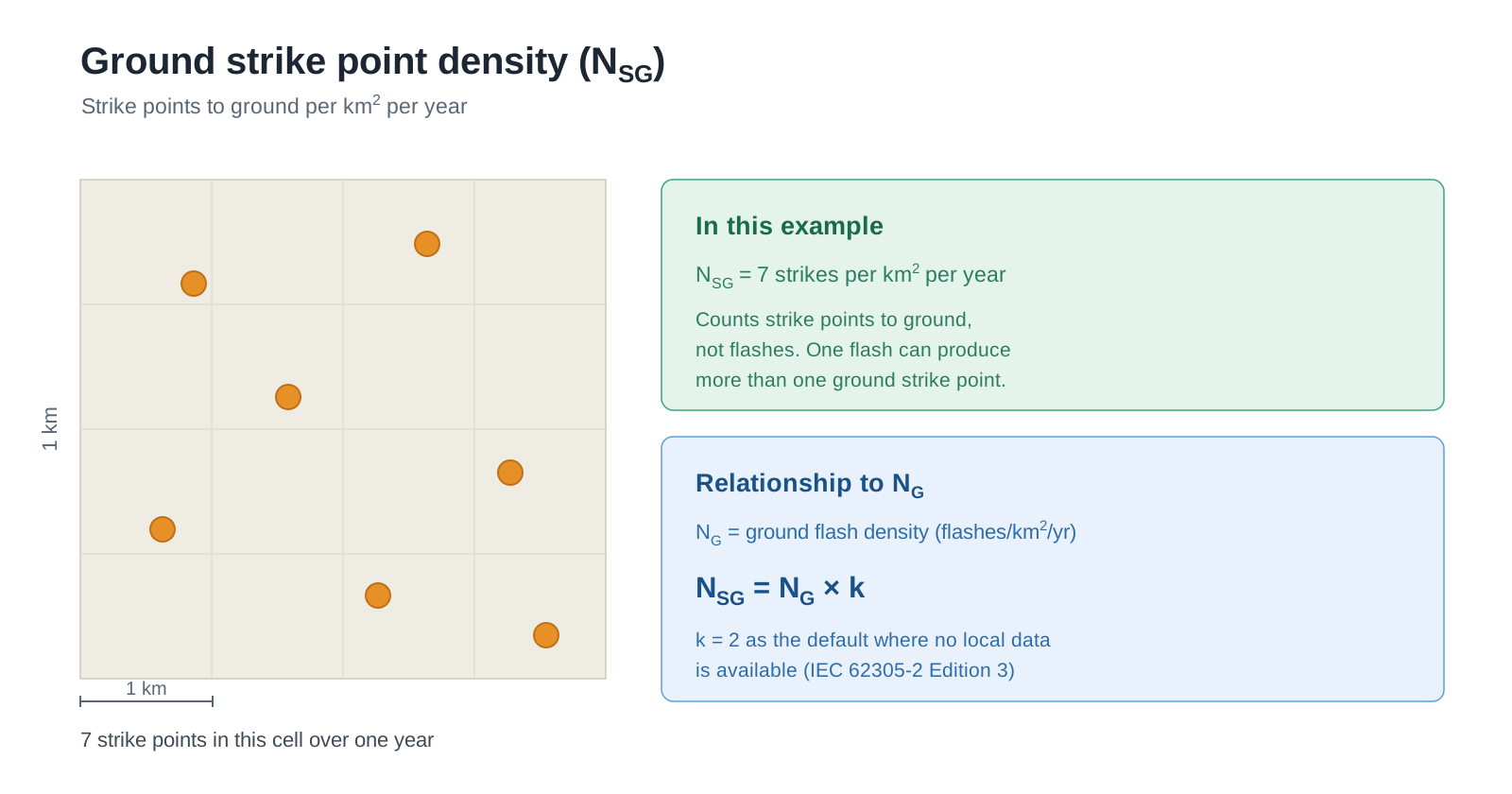
Of all the changes in the 2024 third edition of IEC 62305-2, one looks like a footnote and behaves like a lever. The standard replaced lightning flash density, NG, with lightning ground strike-point density, NSG, in the evaluation of the expected average annual number of dangerous events. Two letters changed in a subscript. The effect on a risk calculation can be substantial, and it can move a facility from one protection level to another.
We gave the wider set of 2024 changes a plain-English tour in what changed in IEC 62305-2:2024. This piece goes deeper on the one that most directly moves the numbers.
Why the old metric undercounted
Flash density, NG, counts the number of lightning flashes per square kilometre per year. It sounds like the right thing to count, but there is a subtlety. A lightning location system records a flash at the position of its first cloud-to-ground stroke. The trouble is that a single flash does not always touch ground at one place. The subsequent strokes within the same flash can reach earth at different points, sometimes hundreds of metres apart.
So flash density answers the question "how many flashes happened here," when the question that actually matters for risk is "how many times did lightning touch the ground here." Those are not the same number. Every additional ground contact is a real point where lightning could strike a structure, and NG simply does not count them. The metric quietly undercounts the hazard.
What ground strike-point density fixes
Ground strike-point density, NSG, counts strike points rather than flashes. It captures every place lightning actually reaches the ground, which is exactly the quantity a risk assessment needs when it estimates how often a given structure can expect to be struck. It is a more faithful representation of the physical threat, and that is why the 2024 edition adopted it.
That factor is the heart of why this change matters. If your earlier assessment used flash density and your new one uses a properly determined strike-point density, the expected number of dangerous events can roughly double on that input alone. Everything downstream, the comparison against the tolerable risk limit and the protection level that follows, moves with it.
The catch: your data has to qualify
Here is where it becomes a practical engineering question rather than a definitional one. NSG is only meaningful if it comes from a lightning location system capable of resolving individual strike points. The standard governing whether lightning data qualifies is IEC 62858. Where a location system meets that standard, you can use a true measured NSG for the facility's location.
Where it does not, you cannot simply use the raw flash density and call it done. The accepted approach is to apply a safety margin to NG, in practice doubling it, to approximate the strike-point density you could not measure directly. Either way, the result depends entirely on the quality and provenance of the lightning data behind it. A regional average or an old keraunic-map estimate cannot give you a defensible NSG, because it was never counting the right thing in the first place.
What this means for your assessment
Three practical consequences follow for any facility owner relying on a risk assessment:
- Pre-2024 assessments may understate risk. An assessment built on flash density was counting flashes, not strike points. It is not wrong for its time, but it is built on a metric the standard has now superseded, and it may sit on the optimistic side of reality.
- The data source is now a first-order question. Under NSG, the credibility of your lightning data is no longer a technicality. It is the input that decides the result, and it needs to come from a location system that meets IEC 62858 or be handled with an explicit, documented safety margin.
- A higher number is not automatically a worse outcome. A more accurate count can confirm your existing protection is adequate, or show it is not. The value is in knowing, with a figure that reflects how lightning actually behaves at your site rather than an average that smooths the danger away.
How Aetheric handles it
Our risk assessment studies are carried out against the 2024 third edition, and the lightning data behind them comes from the LRAplus® platform developed by Skytree Scientific, which draws on real-time lightning location system data rather than regional estimates. Under the old flash-density approach, the choice of data source was a detail. Under NSG, it is the difference between a defensible assessment and a number that will not survive scrutiny from an auditor or insurer. Skytree Scientific's guide to the standards covers the methodology in more depth.
The two-letter change in the subscript is the standard catching up with the physics. The assessments that protect your facility should do the same.
Was your assessment built on flash density?
If your risk figures predate the 2024 edition, we can reassess against ground strike-point density and tell you whether the result changes.
Request a Risk Assessment